From Sound to Symptom
Real-Time Respiratory Signal Understanding for Conversational Healthcare Agents
July 31, 2026 | 2 min read

Subhabrata Mukherjee, PHD
Chief Science Officer, Co-founder
Hippocratic AI

Dr. Herprit Mahal MD, FACP
Associate Chief Medical Officer,
Hippocratic AI

Tanmay Laud,
Staff Applied Scientist,
Hippocratic AI
When a patient coughs mid-sentence, a clinician notices. But traditionally AI doesn’t — it filters the cough out as background noise and continues on.
That is a health issue and a safety issue.
A cough is one of the most common clinical signals there is. Until now, no conversational AI system has been able to hear it, and address it in real time. Our research team set out to close that gap, and the result, HealthCUES, is the first real-time system that detects and classifies coughs inside a live conversation. The work has been accepted at SIGDIAL, one of the leading conferences on dialogue systems research.
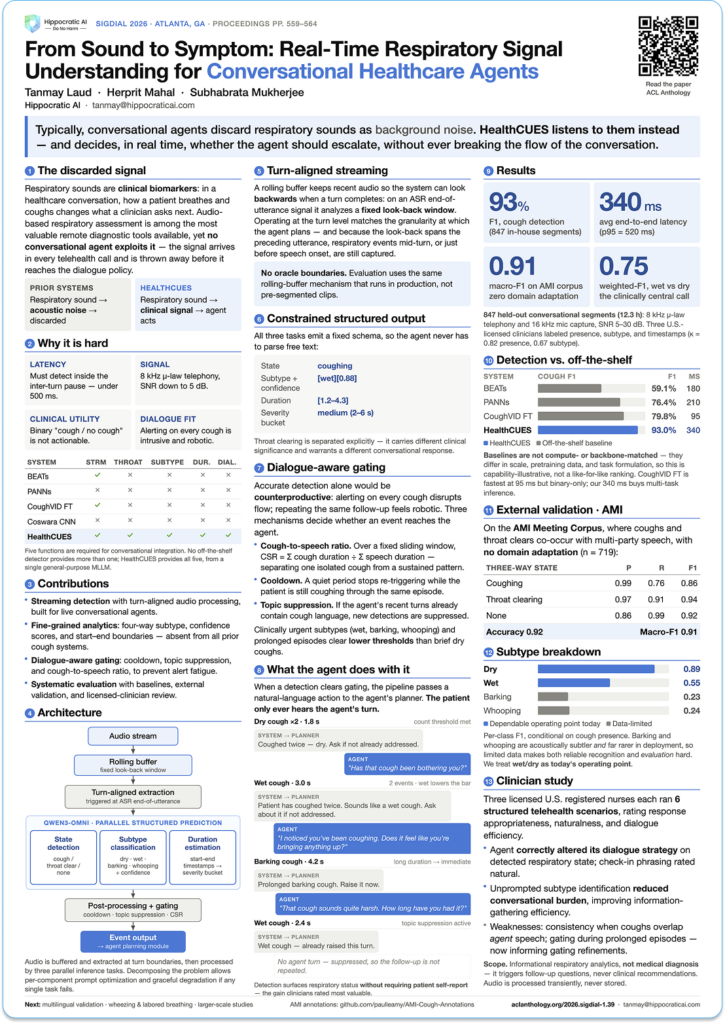
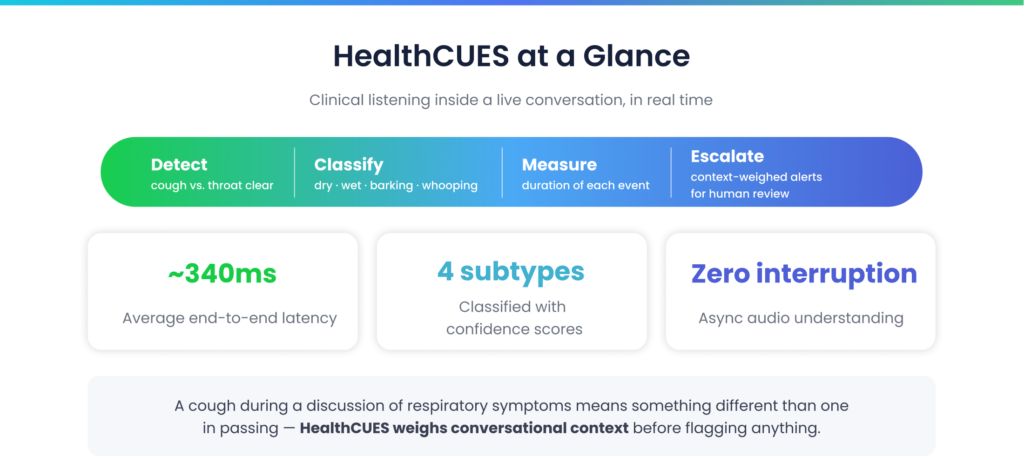
HealthCUES is the first system to monitor respiratory sounds inside a live conversation. It doesn’t just detect a cough, it distinguishes coughing from throat clearing, classifies the type (dry, wet, barking, whooping), and measures duration, all in about a third of a second, without interrupting the conversation.
Why this matters
When a clinician speaks to a patient, the words are only part of the context. A cough that interrupts a sentence, an audible wheeze, a repeated throat clear — these are all data points that humans use to guide the conversation. A wet, productive cough shifts follow-up questions one way; a persistent dry cough may instead elicit follow-up questions about medication use or reflux. These sounds can change the progress of the conversation itself. Hearing a cough prompts the clinician to ask specific questions, questions that might never come up if the patient doesn’t volunteer the symptom. Patients often don’t. They may normalize their cough, not notice it, or not think it’s relevant to the discussion.
Conversational AI systems that process speech alone miss all of this. They transcribe the words in isolation, which means they lose exactly the signals a clinician would respond to. Building cough detection and subtype classification into the conversation restores a layer of clinical listening: the agent can notice a wet cough the patient never mentioned, ask the follow-up questions a clinician would ask, and flag concerning patterns for human review. This isn’t diagnosis, it’s the more basic skill of paying attention to the patient rather than just the transcript, and it’s a prerequisite for AI agents doing safe, clinically meaningful patient conversations.
HealthCUES goes well beyond detecting that a cough happened. It distinguishes coughing from throat clearing, classifies cough subtypes (dry, wet, barking, whooping) with confidence scores, and measures how long each event lasts. It does this in real time, with an average end-to-end latency of 340 milliseconds, without interrupting the flow of the conversation. To avoid overwhelming clinicians with alerts, the system also weighs conversational context before flagging anything. For example: a cough during a discussion of respiratory symptoms means something different than one in passing.
For healthcare, the implication is direct: AI agents that conduct patient conversations at scale can now listen the way clinicians do — catching the symptom the patient never mentioned and making sure a human sees it. That’s a small skill with a large surface area, and it’s a necessary step toward conversational AI that is genuinely attentive to patients.
Results
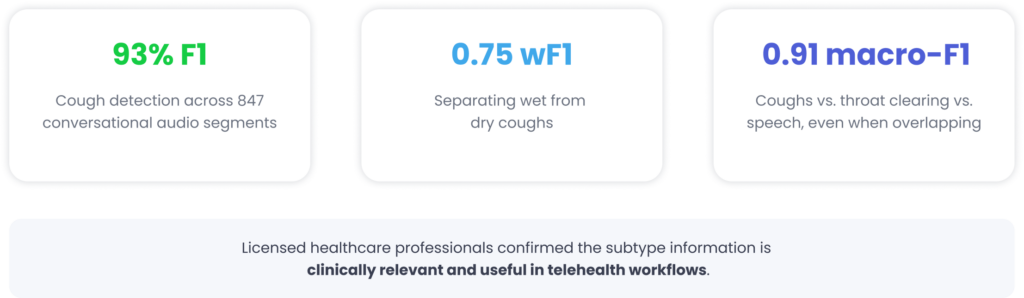
In evaluation on 847 conversational audio segments, the system detected coughs with 93% F1 and separated wet from dry coughs with 0.75 weighted F1. On an external meeting corpus, it reliably distinguished coughs, throat clearing, and speech even when they overlapped (0.91 macro-F1). A study with licensed healthcare professionals confirmed that the subtype information is clinically relevant and useful in telehealth workflows.
- HealthCUES (SIGDIAL 2026): https://aclanthology.org/2026.sigdial-1.39/
- Hippocratic AI Research: https://hippocraticai.com/research/
Further Reading