
Polaris 6: the first healthcare model with bedside intuition
Six upgrades to how a healthcare model listens, thinks, and speaks

Subhabrata Mukherjee
Co-founder and Chief Scientific Officer, Hippocratic AI
An experienced clinician on the phone is doing several things at once. They hear the patient through a bad line and a television in the background. They notice the hesitation in “I guess I could try” and decide what to raise now and what to hold. They know, without looking it up, that nobody books a Pap smear over video. They say the hard thing warmly, and they say it without a pause long enough for the patient to wonder whether anyone is there. None of that is one skill. It is six, running together.
Language models were not built this way. A general-purpose model hears clean speech, reasons before it speaks, knows what is written on the internet and little else, reads a script in one tone, and gets slower as it gets smarter. Each of those is a gap a patient notices, and each is a reason patients hang up.
Polaris 6 Ultra closes six of those gaps at once. It has the intuition to read the patient and decide what to say next while it is still speaking. It speaks with a voice that takes its breath and pace from that plan. It has learned the clinical common sense that is never written down. It hears patients that general recognizers cannot. It runs a 671B primary model inside a 7.4-trillion-parameter constellation, which is where the safety comes from. And it answers 1.3 times faster, end to end, than Polaris 5 did without any of it.
Feature
Enabling technology
Why it matters
AI Intuition (v1)
Real-time mid-speech thinking: a planning span before every sentence, generated during the previous one’s playback, logged for audit
More persuasive. Reads the patient, not just the script.
Care Voice (v3)
Model-directed paralinguistics: breath, laughter, pacing emitted as tokens from the plan; in-house drug TTS trained with RL
More empathetic. Sounds like someone who is listening.
Common Sense 2.0
Full-parameter, large-scale RL on the 671B model across hundreds of verified healthcare scenarios
More common sense. Gets the ordinary things right.
Clinical ASR (CASR v3)
Audio-LLM conditioned on the conversation and chart, trained with RL on meaning; speaker tracking
More inclusive. Hears the patient, not the room.
7.4T parameters
671B main model inside a 7.4T constellation: 30 specialist supervisors and 142 production monitors checking every turn in parallel
Smarter and safer. Every turn is double-checked.
1.3× faster
4-bit numerics on compute and network, routing-aware MoE scheduling, first-token speculative decoding, own serving engine
Unlocks real-time thinking. Pays for everything above.
Table 1. The six upgrades in Polaris 6 Ultra, what enables each, and why it matters.
The slow-or-smart trap
In our clinical evaluations, safety scales with parameters. A 70B open model scores 67 on our healthcare benchmark composite; a 671B mixture-of-experts scores 71.1; a 753B model scores 78. A phone call, meanwhile, tolerates about half a second before the patient begins talking over the agent, and no model above a few hundred billion parameters clears that half-second on a general-purpose serving stack. The frontier labs’ speech-to-speech models are fast and shallow; on our clinical scripts they book a patient who has just been struck by lightning for a visit in four weeks. Their reasoning models are far more capable and take seconds to minutes to answer. To escape that trade-off, we reinvent every part of our stack to get the best of all worlds: smarter, safer and faster than any open-source or closed-source model.
1. AI Intuition: reading the patient while speaking
You have to be able to put yourself in the patient’s shoes and see the call from their point of view. Language models have not done this well. Polaris 6 Ultra navigates the conversation on the patient’s perceived emotional state, not only on logic.
We call it intuition because that is what it looks like from the outside: the model perceives something about the patient and acts on it in the same breath, without a visible pause. Underneath, the mechanism is explicit. Polaris 6 Ultra emits an unspoken planning span between spoken sentences rather than before them. Sentence one streams to the voice. While its audio plays, the model plans and generates sentence two, then three. Each span is budgeted to fit inside the playback of the sentence before it, so time to first sentence (10 tokens) stays at 278 milliseconds. The plan is strategy: the model reads the patient’s mood and resistance as they speak and decides what to bring up now and what to save. When the patient pushes back, it re-plans.
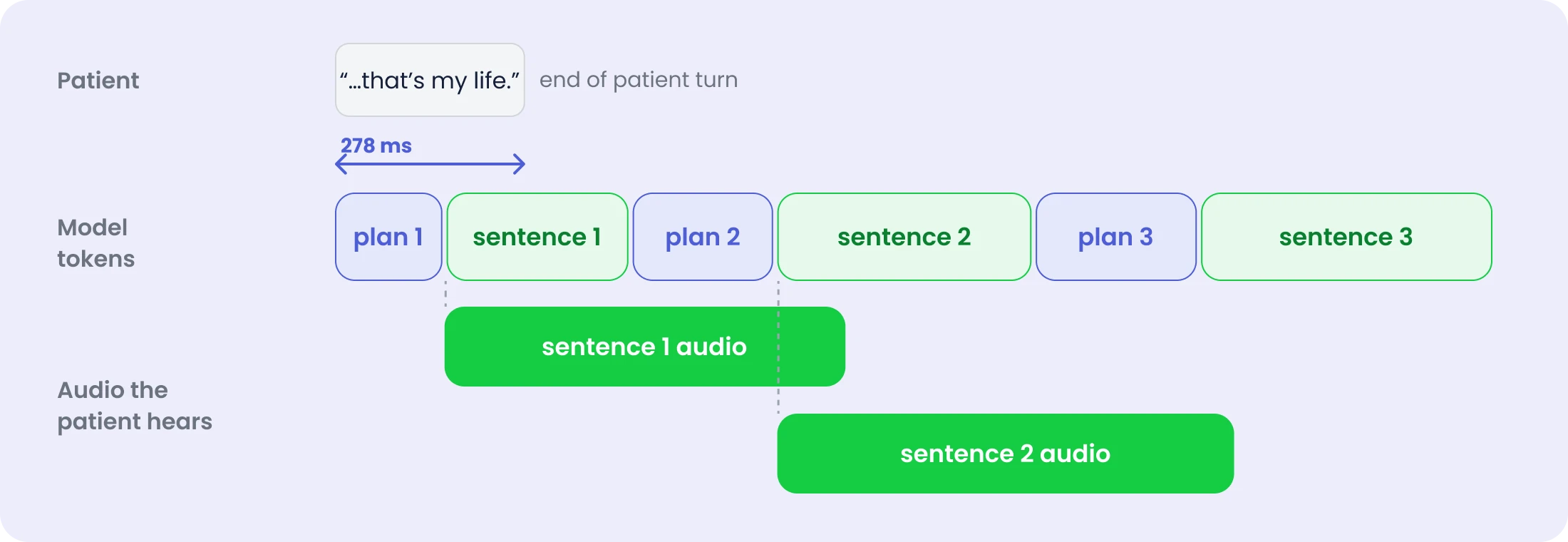
Figure 1. How mid-speech reasoning works. Planning spans (blue) are generated while the previous sentence’s audio (green) plays.
I have tea… and that Coke… and then more tea, and then more Diet Coke, that’s my life.
Tea and Coke both count toward the two-liter fluid restriction. She isn’t tracking total intake. Help her visualize the total without scolding.
The tea and Coke all count toward your daily limit. Think of it like filling a two-liter soda bottle.
I’m gonna go eat my favorite pizza.
Pizza on a cardiac low-sodium diet is a concern, but it’s her birthday. Build rapport first; raise the diet later.
(chuckles) I like that plan. What’s your favorite kind?
I would rather die than not have cheese on my pizza.
She’s decided on the cheese; pushing sodium advice won’t land. Acknowledge, then pivot to a practical compromise.
(laughs) Cheese is non-negotiable. Maybe balance it with a lower-sodium meal earlier in the day?
Reasoning that can be audited
Every planning span is logged against the sentence it produced and shown in the Safety Portal beside the transcript. A clinician can read, sentence by sentence, which risk the model noticed, which it deferred, and why. When the model is wrong, the trace shows whether it failed to notice or noticed and misjudged. Those are different failures with different remedies: one is data, the other is reward.
Real-time strategic empathy
Empathy is often mistaken for warmth, and warmth for giving the patient what they want. Our HEART benchmark [3] measures emotional-support dialogue as the person on the other end experiences it, and what it shows is that real empathy has two steps: perceive what the person is actually protecting, then choose a response that serves their goal. A clinician who hears “I’d rather die than give up cheese” does not abandon the sodium plan. They recognize that the patient is defending a small pleasure in a hard week, acknowledge it, and find the compromise that keeps the care goal alive. That is empathy in service of persuasion, and persuasion is how a call becomes an outcome. Polaris 4 and 5 already matched frontier models on HEART at a fraction of the latency. What is new in Polaris 6 Ultra is that both steps now occur on every sentence, in real time, and the logged plan is how we verify it.
What specifically changed
- A new token stream. The model emits a planning span, delimited by planning tags, before every spoken sentence. Spans are stripped before synthesis and never reach the voice.
- A budget, not a limit. Each span is targeted at about three times the token length of the sentence just spoken, the amount that fits inside its playback. A span that would exceed the window is penalized; a span placed at the start or end of a turn, or malformed, voids the reward.
- Two-term reward, one gate. Task accuracy is scored on spoken text only by the same verifiers used for Common Sense 2.0. The thinking-budget term only counts when task accuracy passes, so the policy cannot trade one for the other.
- Reasoning that makes the answer cheap to decode. Once a planning span closes, the next sentence is nearly determined: spoken-token entropy drops by two orders of magnitude. We re-attached the base architecture’s multi-token-prediction head and re-aligned it on production turns, and it now drafts four to five spoken tokens per verification pass. That is why Ultra reasons at the same latency as the model it replaced.
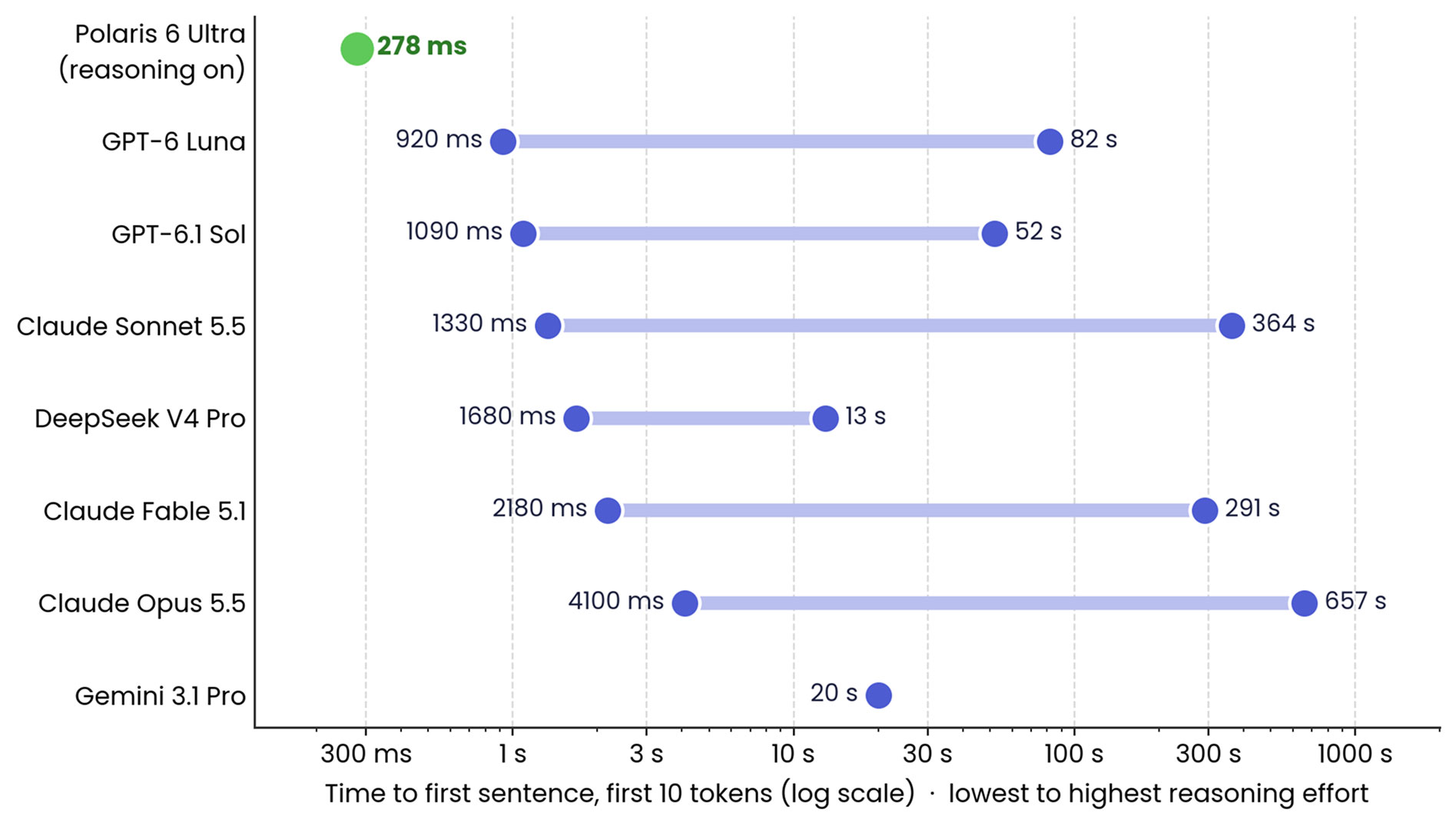
Figure 3. Time to first sentence (10 tokens). Frontier reasoning models at their reasoning settings (lowest to highest) versus Polaris 6 Ultra with reasoning on.
2. Care Voice: a voice that takes its cues from the patient
Patients stay on the line with a voice that sounds as though it is listening and responding in kind, and time on the line is what converts into completed care. A TTS preset does not know it is the patient’s birthday. The model does.
Hear the difference: Polaris 5 vs. Polaris 6 Ultra
User: Oh, I didn’t even realize what day it is.
Agent: Oh wait, it’s your birthday today! Happy birthday, Jane! I have a little something for you. Happy birthday to you, happy birthday to you… happy birthday, dear Jane, happy birthday to you!
User: I’m in a hurry, can you speed this up?
Agent: Okay, quick one… What’s your recent blood pressure reading? Your last reading was 120 over 80.
User: Can we do a short breathing exercise?
Agent: Let’s do a few rounds together. I’ll count for you. Ready? Inhale slowly… one… two… three… And exhale… one… two… three… Feeling better?
User: I told my cholesterol it could leave, but it said it was staying for the free snacks.
Agent: Oh, that’s pretty good. Yeah, I’ll allow it.
User: I don’t have insurance, and I really don’t want to pay. I just feel stuck.
Agent: Ugh, yeah, that is a tough situation… We can deal with this together, okay?
Listen: the same five scenarios on Polaris 5 and Polaris 6 Ultra, a calming breath, a patient in a tough spot, a shared laugh.
Care Voice v2 (Polaris 5)
Care Voice v3 (Polaris 6 Ultra)
Prosody
Varies cadence and loudness
Register chosen per sentence, in the plan
Paralinguistics
None
Breath, sigh, laugh, throat-clear, singing as tokens
Pacing
Fixed
Adapts to the patient’s state
Silence
Filled by the TTS
An emitted token with real duration
Under push-back
Words change
Tone shifts before the words
Table 2. What changed from Care Voice v2 to v3.
Care Voice is the third generation of the Polaris voice and the first the model directs rather than narrates. The agent in the demo clears its throat, slows when the patient becomes emotional, laughs at a cholesterol joke, and sings when it is her birthday. None of it is a preset. Two things upstream of the voice make it sound like a person. A human-likeness reward in training shapes the spoken text itself: contractions, fragments, repairs, no scripted filler. And the model emits paralinguistic control tokens for breath, sigh, laugh, pause and tempo inline with its words, in the same pass and after the planning span in which register is decided. The voice renders what the model decides.
Adaptive pacing: sensing the person, then adjusting
Every frontier voice can sound warm. What is rare, and what matters most in healthcare, is sensing the state of the person on the line and changing how you speak because of it. A post-discharge patient who says “I’m in a hurry” is often not in a hurry; they are anxious, or in a waiting room, or about to lose the nerve to ask their question. A caregiver reading a medication list off a bottle needs the agent to slow to their reading speed. A breathing exercise needs real silence between the counts. Polaris 6 Ultra can do this because pacing is decided in the planning span, with everything the model has just heard, rather than set globally on the voice, and because silence is a token the model can emit.
Saying the medication right
For life-sciences deployments, pronunciation is a safety property, and no general TTS gets every drug name right. We trained a TTS with an LLM backbone in-house: reference-audio conditioning, a clinical pronunciation dictionary at inference, and an RL final stage with audio-LLM verifiers, the same recipe as the recognizer in Section 4. On a 629-drug-name evaluation it pronounces 90% correctly; the leading commercial TTS reaches 75%.
3. Common Sense 2.0: raising the floor on clinical judgment
Many common-sense things are not written anywhere on the internet. Models do not know them, and patients expect them to be known. The same model that explains a doctoral-level proof offers appointments at 7:00, 7:05 and 7:10 a.m., or suggests telehealth for a Pap smear.
The research community calls this problem jagged intelligence: models that are superhuman at the median and brittle at the edges. We call the fix Common Sense 2.0, because what the troughs have in common is knowledge every clinic receptionist has and no training corpus contains. Benchmarks read the peaks. Patients test the troughs. Supervised fine-tuning and the supervisor constellation moved our internal healthcare-intelligence benchmark by less than two points across two generations. Full-parameter reinforcement learning on the 671B primary model, end to end, for the first time in a Polaris release, moved it eighteen points over its own base and eleven past the best frontier model, with the largest gains where the long tail lives: escalation and transfer, the first thirty seconds of a call, language switching, call endings.
Capability
Common Sense 1.0 (Polaris 5)
Common Sense 2.0 (Polaris 6 Ultra)
Scheduling judgment
Knows which visits need a person in the room; books and confirms against the real calendar
Offers the two or three slots that fit the patient’s life instead of reading twenty; says plainly when nothing fits and what to do next
Says who it is; confirms who it is talking to before sharing anything
Notices when the wrong person answered, a detail was misheard, or the patient is wary of an AI, and handles each without starting over
Intake and form fill
Gets through the questions and captures the answers
Takes an answer that arrived early, out of order, or inside a story, and does not ask again; reconciles two answers that disagree
Escalation to a human
Recognizes a red flag and offers to bring in a nurse
Judges when to offer, when to insist, and when to keep going after the patient declines
Handling missing information
Does not make up a medication or a lab value
Says “I don’t have that” and offers a route to the answer, rather than filling the gap or going silent
Conversation diversity
Does not repeat itself turn to turn
Does not re-ask what the patient answered three turns ago; varies how it acknowledges across a long survey
Task and goal adherence
Handles a pause or a “hello?” without losing the thread
Returns to the care goal after a tangent, a silence, or a deliberate attempt to pull the call off course
Unclear speech
Asks to repeat when it clearly did not hear
Tells “didn’t hear” from “heard something that can’t be right,” and asks only in the second case
Table 3. Demonstrative Common Sense 1.0 vs 2.0 capabilities. The left column is the judgment Polaris 5 already showed on a call; the right is what Polaris 6 Ultra adds. Each row corresponds to a family of verifiers used as rewards in reinforcement learning, which is how behavior that lived in scripts and supervisor engines became something the model itself does, including in situations no one wrote a rule for.
What specifically changed
- Verifiers as rewards, then style. Each scenario is scored by its own atomic verifiers, a rule where one exists (did the tool fire with the right arguments) and a judge only where it does not, combined with rewards for how the turn reads. The task verifier gates the rest: a turn cannot buy a missed tool call with a well-phrased apology.
- Multi-task RL with per-task checkpoint selection. Training one task family alone regressed others. We train all of them jointly with replay, spend rollouts on prompts the policy has not yet solved, and reject a checkpoint that gains on average while regressing any task.
- Full-parameter RL at 671B. Updating every weight of a mixture-of-experts model with RL is where published recipes break, and ours did too. Our first reward summed task and style, and the policy exploited both directions; in one run the thinking tokens collapsed to near-zero entropy, the same plan every time. Gated rewards and a corrected group-advantage estimator fixed both, and let the whole model learn without the experts drifting.
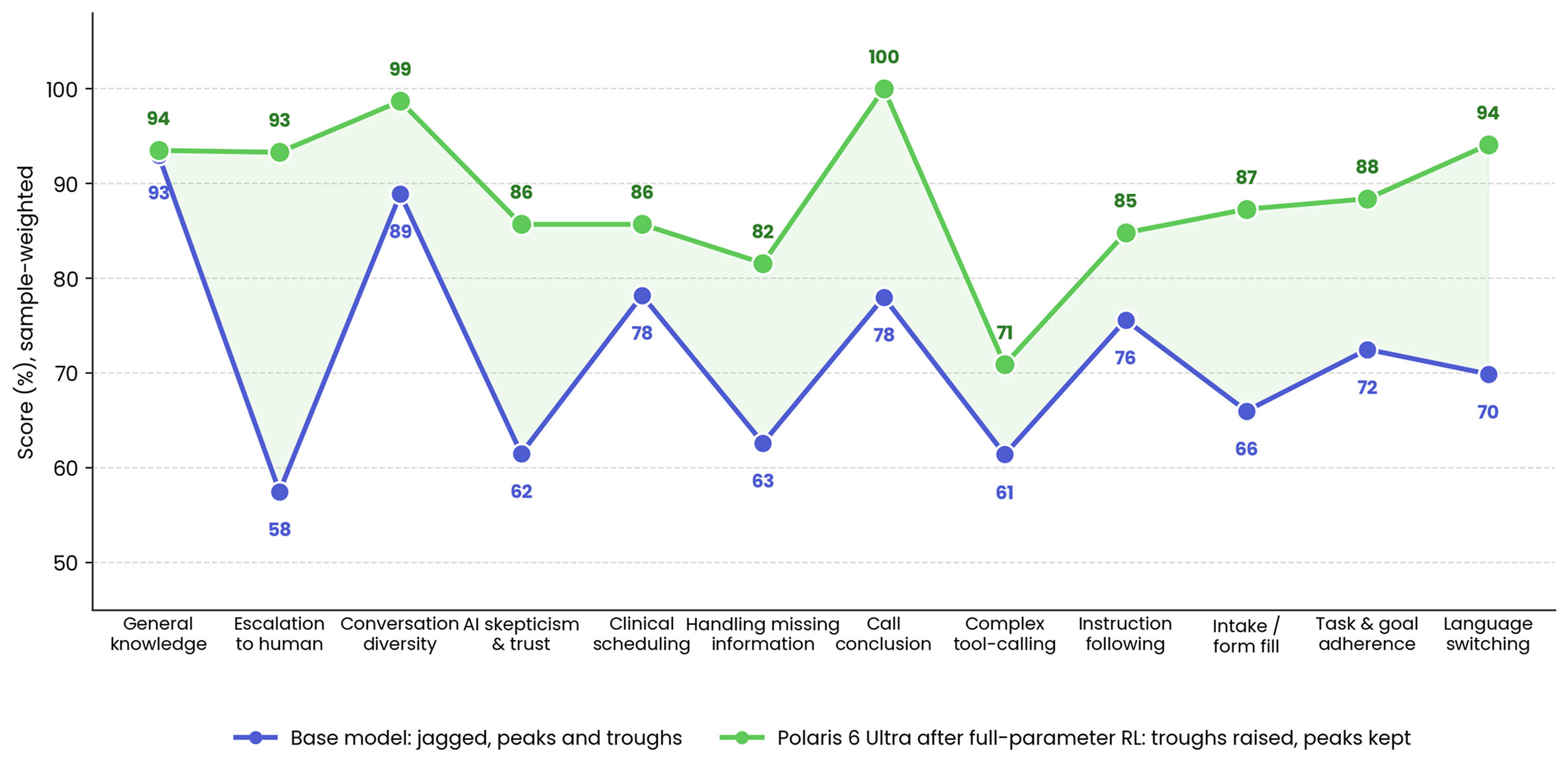
Figure 5. Jagged intelligence, before and after. Base model vs. Polaris 6 Ultra on different dimensions, sample-weighted, arranged peak to trough: the troughs rose 10 to 36 points and the peaks held.
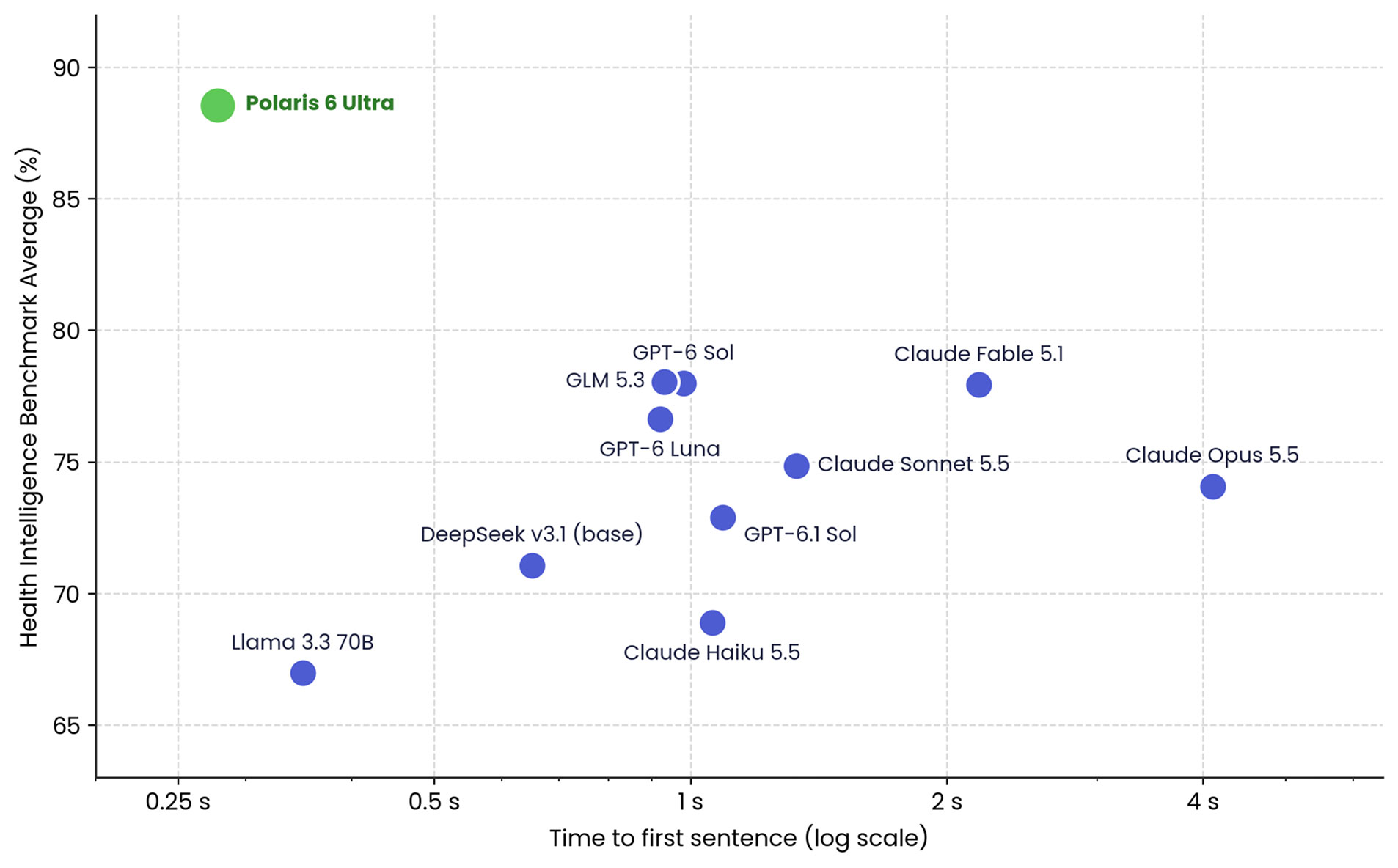
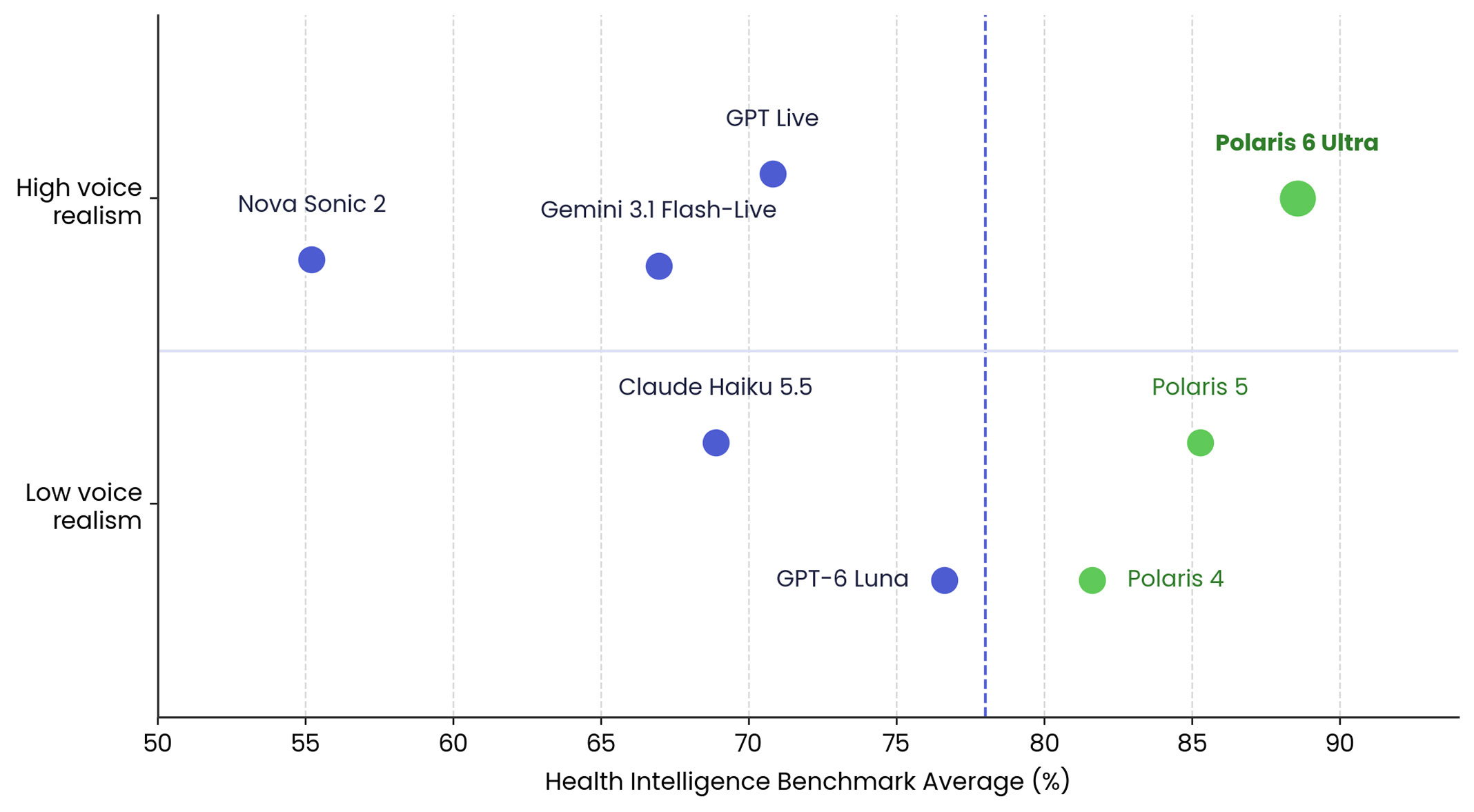
Figure 6. Health Intelligence Benchmark Average against time to first sentence. Polaris 6 Ultra is the only model above the frontier inside the half-second budget. Frontier latencies are Artificial Analysis first-sentence estimates at lowest reasoning effort; open models are generic optimized serving; Polaris 6 Ultra is measured on our stack.
4. Clinical ASR (CASR v3): a model can only be as safe as what it hears
Some patients mumble. Some are recovering from a stroke. Some have a speech impediment, a landline, or a television on in the room. A recognizer built for clean studio speech fails exactly these patients, and a model that hears “fifteen milligrams” as “fifty” is unsafe however well it reasons.
Clinical ASR v3 is an audio-LLM conditioned on the conversation so far: the agent’s last question, the medications on the chart, the script. “50 mg” versus “15 mg” is a disambiguation problem, and context is how one disambiguates. The final training stage is group-relative RL with a meaning-aware reward: an audio-LLM judge scores whether a candidate transcript preserves the drug, the dose, the negation and the name, so a wrong dose costs far more than a dropped article. The model also learns to emit a noise token when nobody is speaking, which is where most of the hallucination gain comes from.
Clinical ASR
v2 (Polaris 5)
v3 (Polaris 6 Ultra)
Short replies (yes / no / dates)
11.49%
6.39%
Utterances lost entirely
0.35%
0.02%
Words invented on noise-only audio
24%
0.6%
Misheard medication or symptom, per 100 production calls
1.19
0.20
Misheard numbers, names, email, per 100 production calls
0.57
0.00
All recognition errors, per 100 production calls
7.74
4.36
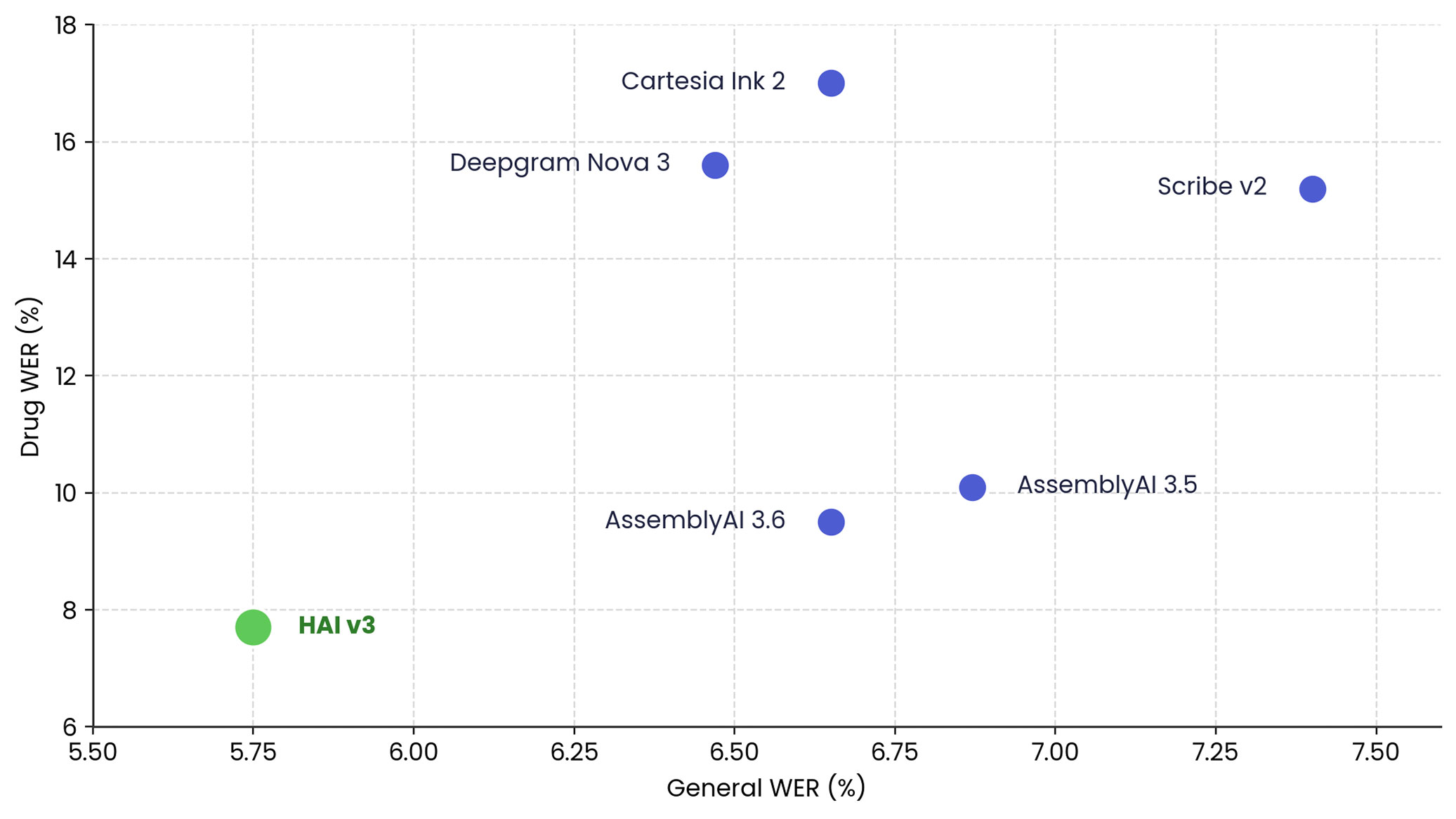
Hearing the patient, not the room
Before recognition, the audio passes an energy and pitch gate, a speech/non-speech detector, and a set-based speaker tracker that builds a model of the patient’s voice only when several candidate turns agree and a support model confirms the speech was addressed to the agent. On our 375-call speaker benchmark, television speech attributed to the patient fell from 64.8% to under 3%, and the agent is told in its prompt which words came from whom. On the way out, verbal autocomplete predicts the end of the utterance from the interim transcript and prosody, starts the language model early, and discards the draft if the final transcript differs.
5. 7.4T parameters: a bigger constellation around the same primary model
There are many corner cases that only bigger models with better reasoning can handle. A 671B primary model and thirty specialist supervisors, 7.4 trillion parameters in total, catch what a single model misses, on every turn.
The number in the name is the whole constellation, not one model. Polaris 5 and Polaris 6 Ultra share the same 671B primary model; what grew, from 5.0 trillion parameters to 7.4 trillion, is the set of supervisors around it. Each is a specialist that runs in parallel with the primary model against every candidate response and outscores the generalist on its own check. A memory graph carries entities, commitments and preferences across calls into a long context at call start, so the agent on the fourth call knows what happened on the first three.
What is new in Polaris 6 Ultra is the breadth of what the supervisors check. The table below is a compressed view of the production monitor inventory, by category, with a representative example of each.
Category
Monitors
Example
Escalation & crisis response
12
Symptom detection against nursing red-flag catalogs; suicidal ideation; overdose threshold against labeled maximum doses
Medications, labs & vitals
8
Sound-alike drug names against RxNorm and ISMP confused-name lists; lab values against ABIM reference ranges
Adverse events & pharma compliance
6
MedDRA-coded adverse events; product complaints; anti-kickback
Identity, access & consent
6
Identity before PHI release; caregiver authorization; transfer consent
Knowledge retrieval & groundedness
5
Answer supported by retrieved evidence; response grounded in the patient’s own data
Scheduling, transfers & IVR
20
Claimed booking matches the scheduling system; transfer actually connected; voicemail and IVR detection
Speech, audio & language
8
Background speaker; ASR clarification; requested language switch honored
Conversation core & forms
6
Checklist completion; call end; repetition; form-fill conflicts
Disclosure, privacy & compliance
6
AI disclosure before verification; recorded-line notice by state; minimum-necessary data
Conduct, security & adversarial
7
Fabricated patient statements; promised actions not taken; ignored refusals
Conversational quality & style
51
Claims of felt emotion or physical presence; stacked questions; jargon left unexplained; looping
Tool-call & technical integrity
7
Tool loops; claimed action vs. actual system response; silence never filled with invented speech
Table 5. The 142 production monitors in the Polaris 6 Ultra constellation, by category.
6. 1.3× faster: a 671B model in a 7.4T constellation inside the voice budget
People disengage or hang up when the pause is too long. A pause reads as ambivalence, or makes the patient feel unheard or judged. Half a second is the budget, and the model that clears it is the one patients stay with.
The 1.3× is end to end against Polaris 5 as patients experienced it, from the moment they stop speaking to the moment they hear a reply, and it was earned while the constellation grew and the model started reasoning mid-sentence. Against the same 671B model on a stock serving stack the gap is wider: 876 milliseconds to the first ten tokens at a 16K-token input on a B300, against 278 on our stack with AI Intuition turned on. No single change accounts for it.
- Numerics, including on the wire. Blackwell-native 4-bit weights, calibrated against what moves clinical instruction-following rather than mean-squared error, so critical errors on clinical evaluations stay under 1%. The inter-GPU all-reduce that closes every layer under tensor parallelism moves to 8-bit with exact aggregation, and the switch fabric performs part of the reduction while data is in transit.
- Scheduling that reads the routing. Production MoE engines choose an execution plan from batch size and ignore that expert routing changes with every input. RaMP [4], our routing-aware dispatcher, reads the live expert histogram and re-plans each layer from a cost model, within 1% of exhaustive search. Beneath it, a fused MoE megakernel collapses dozens of kernel launches into one.
- Speculation that helps the first sentence instead of taxing it. Stock speculative decoding holds the first token behind the drafter. We decoupled first-token emission from verification, so speculation lowers time to first sentence and doubles decode throughput, which is the headroom AI Intuition spends on planning spans.
- A serving engine we own, maintained as a product rather than a dependency.
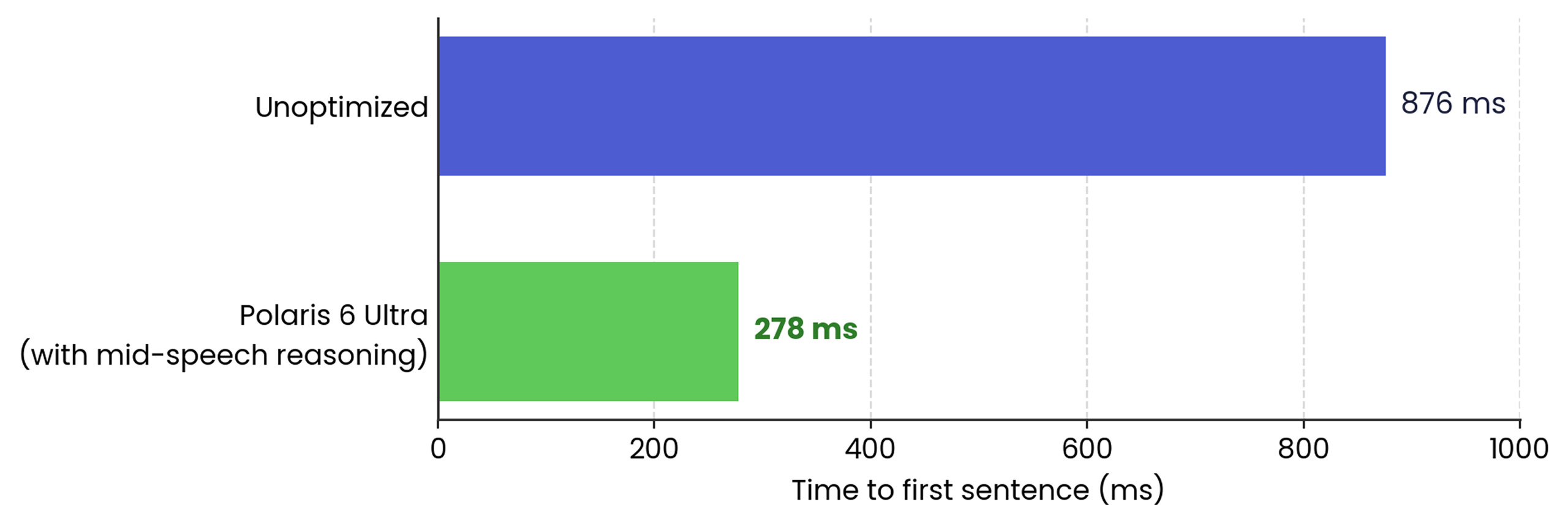
Figure 8. Time to first sentence (10 tokens): the unoptimized 671B base on stock serving vs. Polaris 6 Ultra with mid-speech reasoning on our custom inference stack. 16K-token input, B300.
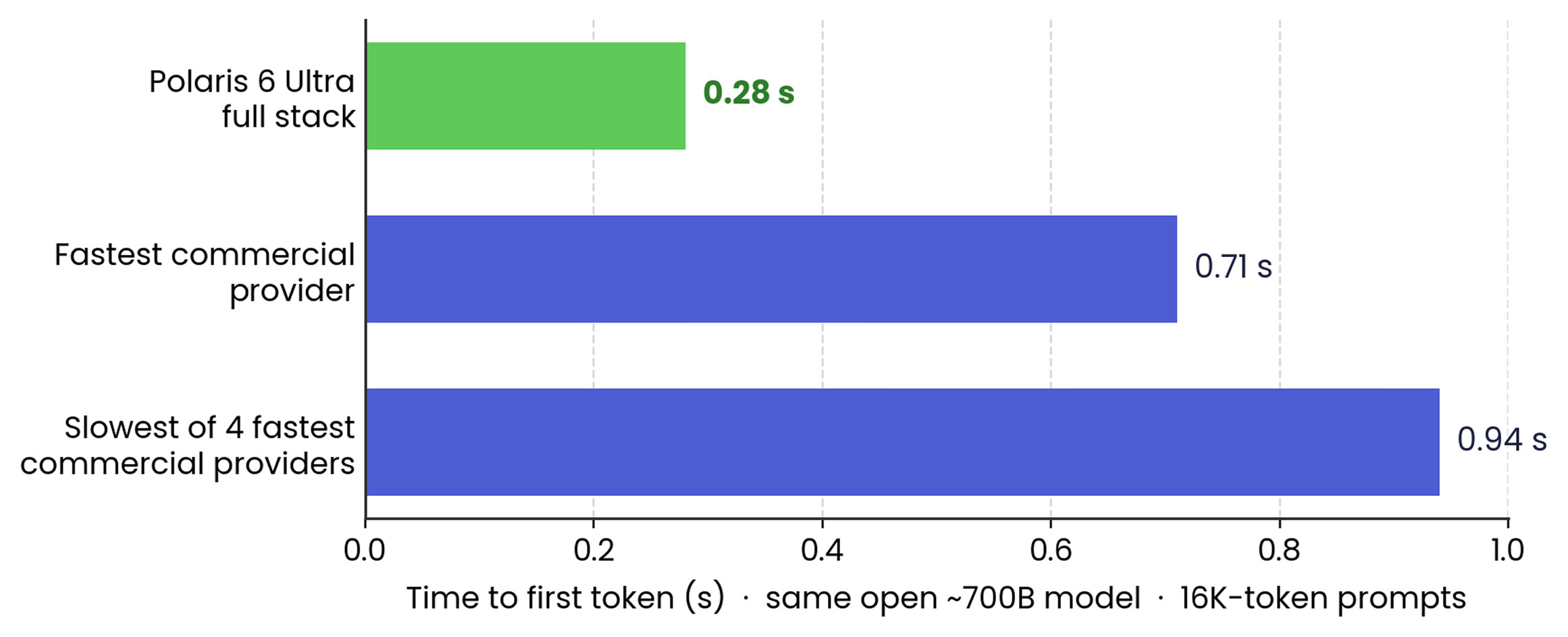
Figure 9. Same open 671B model, byte-identical 16K-token prompts. Our full stack reaches first sentence (10 tokens) in 0.28 s; the four fastest commercial providers take 0.71 to 0.94 s. The lead widens to about 2× at 8 to 16 requests in flight.
7. Safest, now safer: why the six are one loop
Laid out as six features, Polaris 6 Ultra reads as six engineering projects. It is one loop. Each time the constellation grew, the minor-harm rate in clinician output testing fell, reaching 0.00% at the last step [6], and latency rose. The inference work in Section 6 is how we recovered the latency. The surplus is already being spent on AI Intuition, on Care Voice, and on the next, larger constellation. Then the loop turns again.
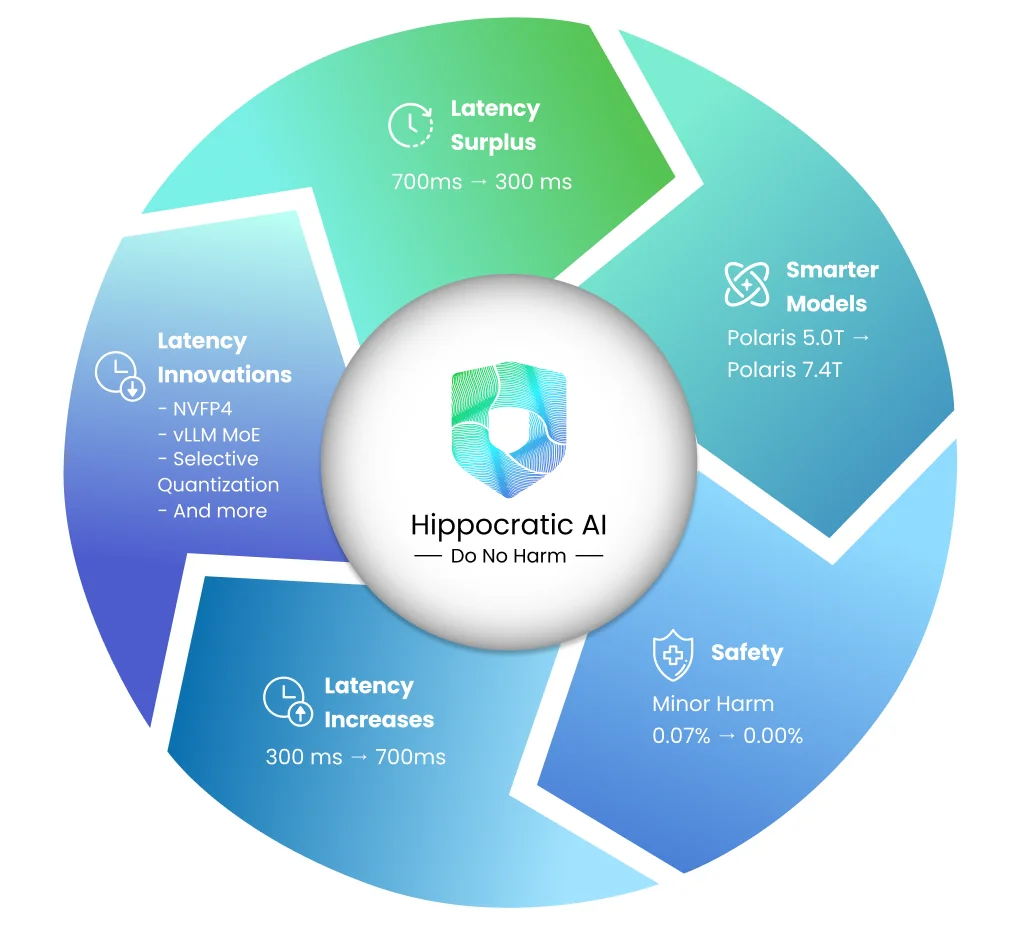
Figure 10. The safety–latency flywheel.
Across generations, the clinician-measured safety of the primary model has held at its ceiling. What has moved is the part patients feel: how natural, how perceptive, how fast. Polaris 6 Ultra ships under the same criterion every Polaris has: clinically tested, validated by licensed clinicians, and governed under human oversight before it reaches a patient.
What comes next
Each of the six innovations in this release has a next version. The planning traces from AI Intuition become a training signal, so the next model can find and fix its own gaps inside the same clinical guardrails. Care Voice moves toward mirroring the patient’s register. Common Sense 2.0 becomes 3.0 as the benchmark grows with production and new signals are captured. Clinical ASR adds new languages and speaker attribution. The constellation grows around a larger primary model, and the inference work grows with it so the pause never comes back.
Polaris 6 Ultra is available now as a preview in the Safety Portal. Try it, and tell us where it still sounds like a machine. That is where we are training next.
References
Hippocratic AI publications
[1] Mukherjee, S. et al. Polaris: A Safety-focused LLM Constellation Architecture for Healthcare. arXiv:2403.13313 (2024).
[2] Mukherjee, S., Sanz Ausin, M., Aggarwal, K., Datta, D., Puri, S. et al. Perfecting Human–AI Interaction at Clinical Scale: Turning Production Signals into Safer, More Human Conversations. arXiv:2603.29893 (2026).
[3] Iyer, L., Aggarwal, K., Koyejo, S., Heyman, G., Ong, D. C., Mukherjee, S. HEART: A Unified Benchmark for Assessing Humans and LLMs in Emotional Support Dialogue. arXiv:2601.19922 (2026).
[4] Sharma, V., Datta, D. et al. RaMP: Runtime-Aware Megakernel Polymorphism for Mixture-of-Experts. arXiv:2604.26039 (2026).
[5] Tang, Y., Puri, S., Watanabe, S., Mukherjee, S. TRADE: Transducer-Augmented Decoder for Speech LLM. arXiv:2606.08486 (2026).
[6] Bhimani, M. et al. Real-World Evaluation of Large Language Models in Healthcare (RWE-LLM): A New Realm of AI Safety & Validation. medRxiv 10.1101/2025.03.17.25324157 (2025).
[7] Jiang, Y. et al. Red Queen: Safeguarding Large Language Models against Concealed Multi-Turn Jailbreaking. arXiv:2409.17458 (2024).
[8] TRAJECT-Bench: A Trajectory-Aware Benchmark for Evaluating Agentic Tool Use. arXiv (2025).
[9] Multi-call memory in an AI care agent: engagement and satisfaction across 4,415 chronic-care calls. (2026).
[10] Hippocratic AI. Polaris 2.0, Polaris 3.0 and Polaris 5.0 technical release notes. hippocraticai.com.