
June 01, 2026 | 5 min read

Vivek Muppalla,
VP of Engineering,
Hippocratic AI
in

Sathvik Perkari,
Software Engineer,
Hippocratic AI
in

Dishank Jhaveri,
Software Engineer,
Hippocratic AI
in
In healthcare, voice is paramount. As a communications channel, conversation is a common denominator across all demographics. It is the one that best lets you engage, persuade, and motivate. These conversational dynamics move patients through their care.
Humans evolved for real-time conversation over millions of years; writing is a recent introduction by comparison (University of Wisconsin–Madison, n.d.). Voice is the native protocol, and it carries trust signals like prosody, tone, and pacing that text can’t carry.
Healthcare is bottlenecked by conversation scarcity. Triage delays and “lost to follow-up” are often what happens when clinical capacity runs out. In a setting where trust determines disclosure, adherence, and follow-through, voice isn’t a stylistic choice; it’s part of clinical effectiveness. That’s why voice AI at scale, for conversations about a patient’s health, chronic conditions, and medications, is a problem worth solving.
That’s what we’re building at Hippocratic AI. Over the past three years we’ve developed Polaris, a voice AI system designed for safe, scalable patient conversations. To date, our agents have completed over 200 million patient interactions at 8.95/10 patient satisfaction. This post walks through what makes healthcare voice AI hard: the latency budget, turn-taking, bandwidth asymmetry, and the safety stakes that change everything. In a follow-up, we’ll walk through the constellation architecture we built to handle it.
Humans experience latency differently in voice than in text. With a chatbot, a three-second pause reads as “thinking.” On a call, the same pause reads as awkward, or worse, rude. Even when the user knows they’re talking to an AI, voice carries different expectations: responsive cadence, soft affirmations, prosody that matches the moment, and the discipline not to talk over someone mid-thought. What feels “business-like” in a chatbot feels cold in a voice agent. Latency isn’t a performance metric here; it’s part of the product’s emotional surface.
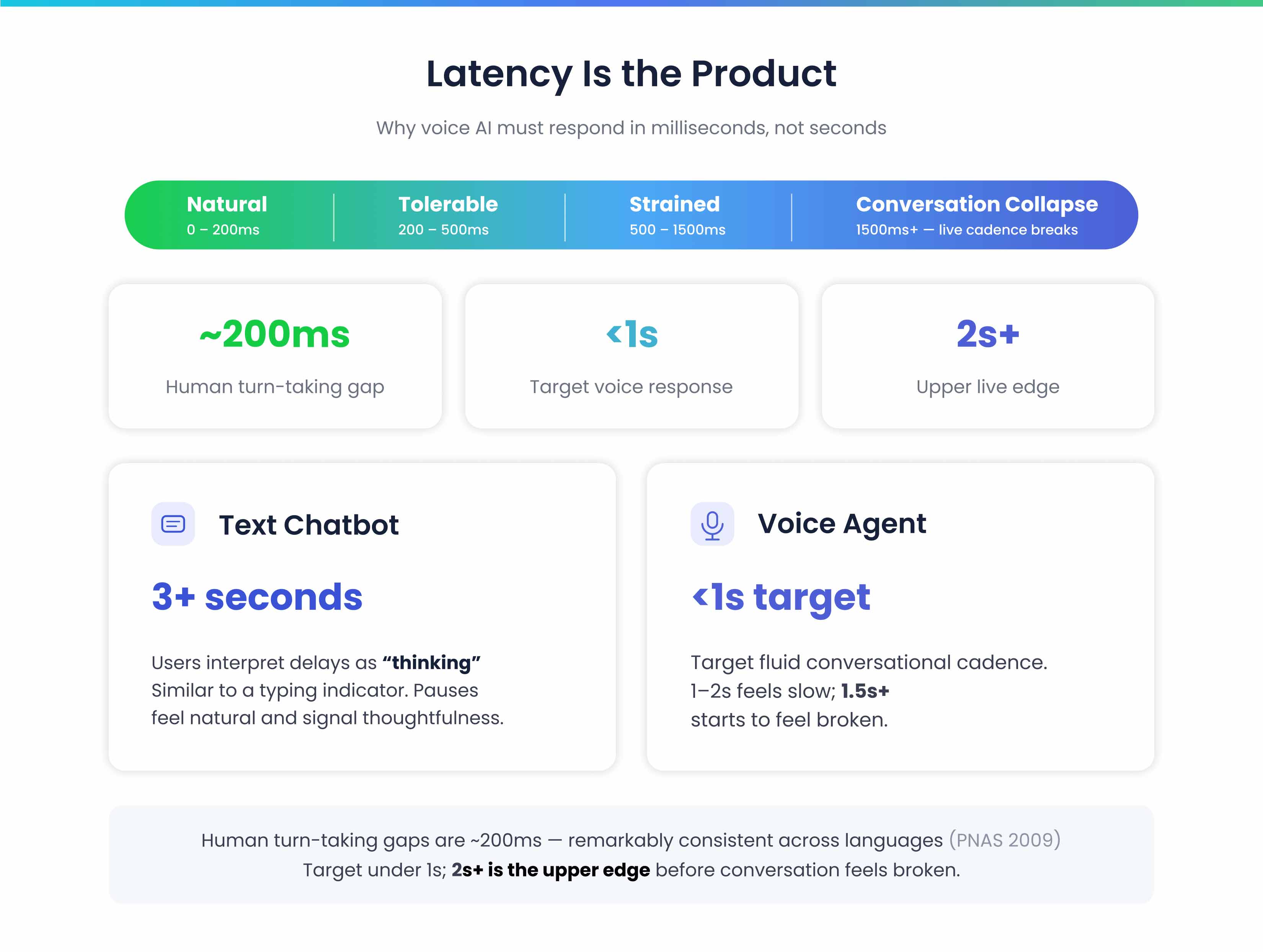
Human turn-taking gaps are typically just a few hundred milliseconds, remarkably consistent across languages (“Turn-Taking Timing Universals,” 2009). Once a voice agent latency takes longer than ~1–2 seconds, the illusion of a realtime conversation starts to collapse. 1.5 seconds is the upper edge of where conversation still feels live. Against that budget, here’s how the pipeline spends its time.
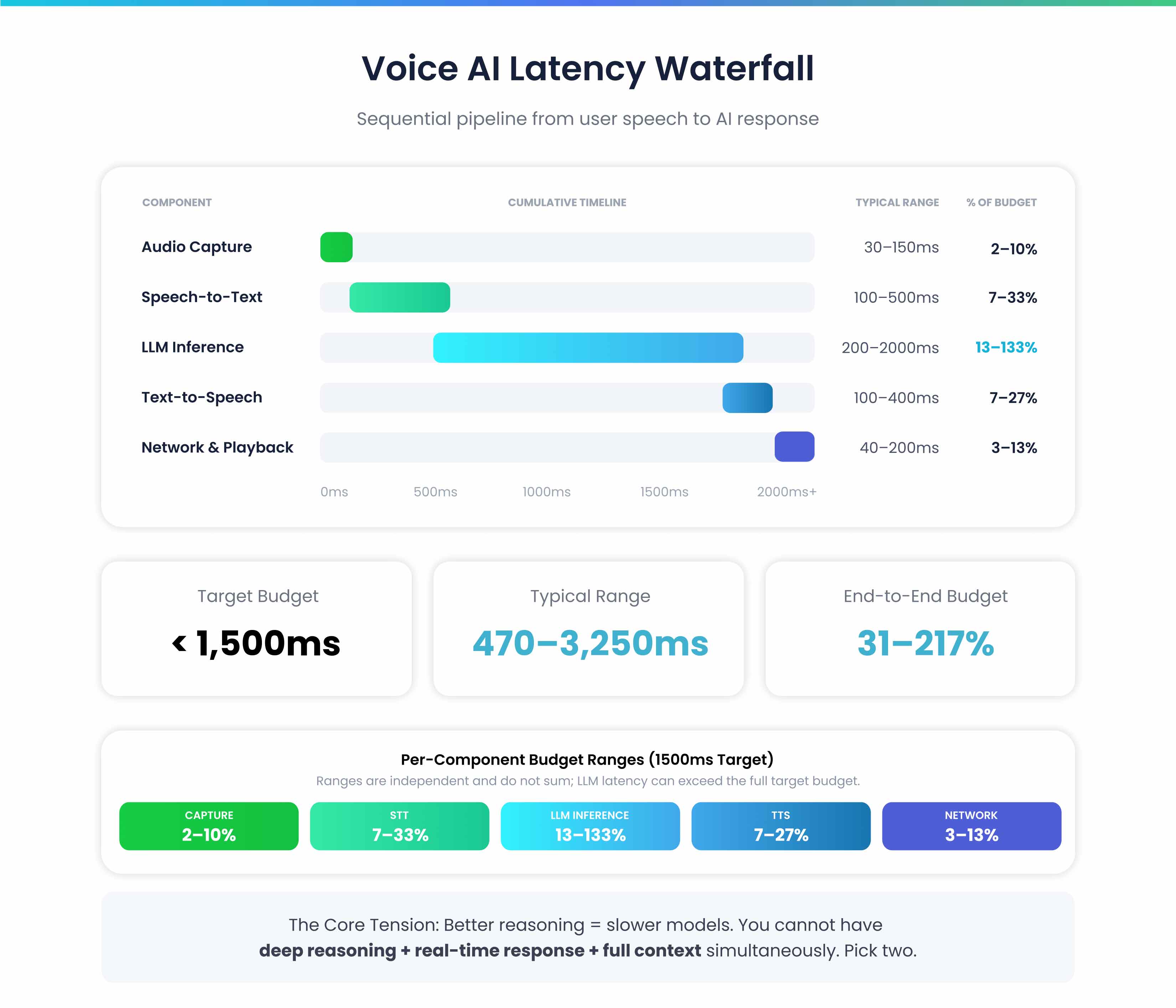
Component | Typical Range | % of Budget |
|---|---|---|
Audio capture & upload | 30–150ms | 2-10% |
Speech-to-text | 100–500ms | 7-33% |
LLM inference | 200–2000ms | 13-133% |
Text-to-speech | 100–400ms | 7-27% |
Network & playback | 40–200ms | 3-13% |
End-to-end | 470–3,250ms | 31-217% |
LLM inference alone can consume the entire budget and then some. Best case, the pipeline runs at 31% of budget with room to spare. Worst case, it’s at 217%, which is why naive ‘just call a frontier model’ architectures collapse in voice. Every engineering choice downstream exists to keep that LLM row from going to 133%: speculative decoding, tiered models, parallel supervisors.
Zoom out and this is the conversational AI trilemma, the CAP theorem of voice: latency, quality, and cost. You don’t get all three at once. Every other voice AI architecture takes a position on this triangle. Ours is to optimize the whole system rather than rely on a single bigger model, a bet that’s held the real-time budget across hundreds of millions of conversational turns in production.
Across more than 50 benchmarks, Polaris 5.0 is able to outperform leading voice-deployable models from OpenAI, Anthropic and Google on the clinical, regulatory, and conversational tasks required to safely manage real patient voice interactions — while running at speeds the frontier thinking models (GPT 5.4 Pro, Claude Opus 4.7, Gemini 3.1 Pro) cannot match (Hippocratic AI, 2026b). View all benchmarks. This achievement is the foundation we are building the next generation on. More on the Polaris solution below.
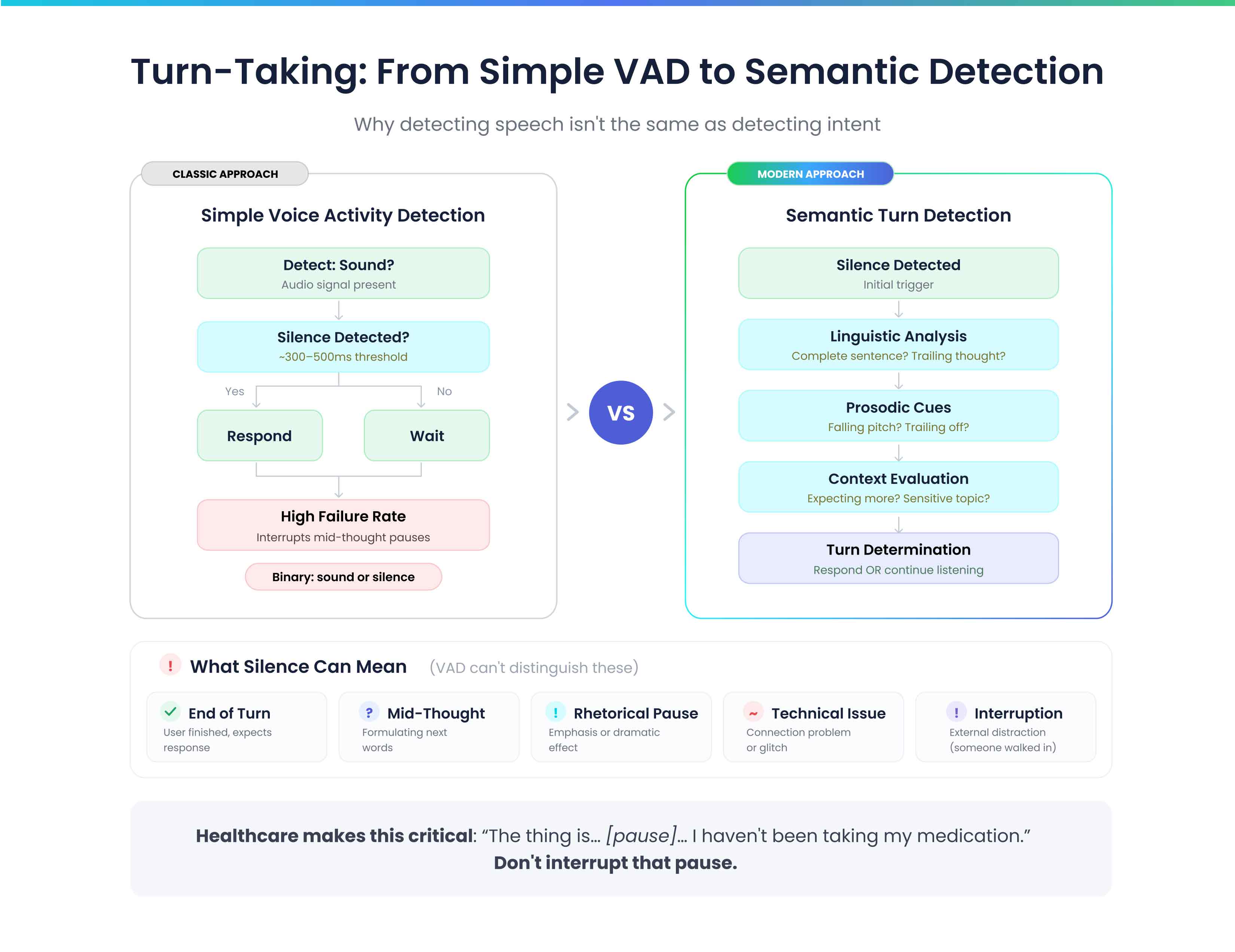
Every voice AI engineer knows this failure: the user says “I understand your point, but…” pauses to think, and the system jumps in, talking over them.
Classic Voice Activity Detection (VAD) fails because it detects speech, not intent. Silence can mean:
Today, our systems combine prosodic signals, linguistic context, and conversation state to decide when a pause means “your turn” versus “still thinking.” In production, Polaris 5.0 delivers 1.5 seconds time-to-first-audio, the lowest latency among healthcare-grade voice AI systems that meet clinical safety thresholds. The open problem is doing this perfectly across accents, emotional states, and clinical contexts.
Healthcare is additionally complicated: patients often pause before disclosing something sensitive. “The thing is… [pause]… I haven’t been taking my medication.” Interrupt that pause and you may lose the most important information in the call.
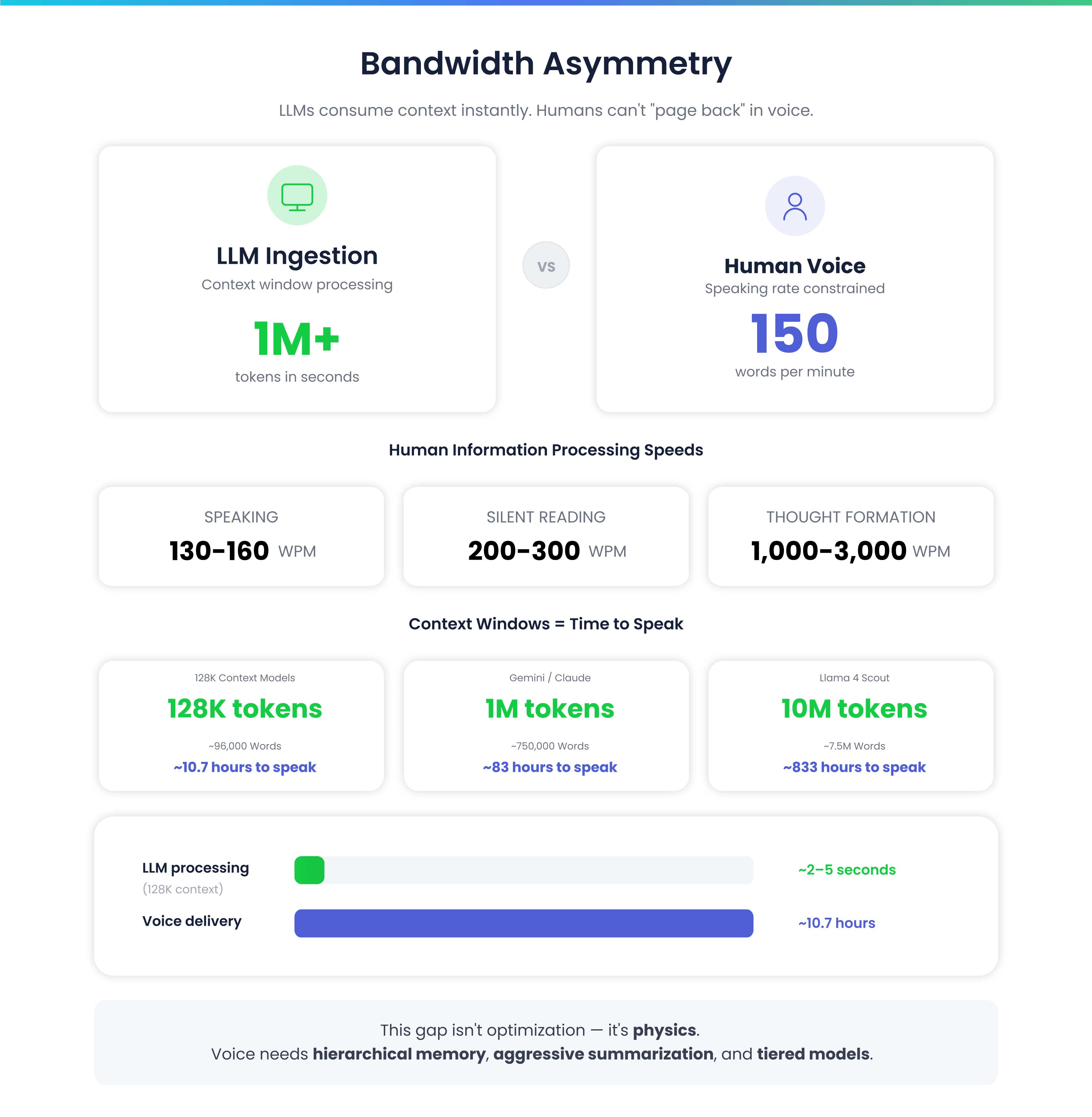
LLMs can ingest enormous context windows in seconds e.g Gemini (1M), Claude (1M) or Llama 4 Scout (10M in some deployments). Humans can’t. Voice is constrained by biology:
Mode | Rate |
|---|---|
Speaking | 130–160 WPM |
Silent reading | 200–300 WPM |
Thought formation | 1,000–3,000 WPM |
A 128K-token context is ~96,000 words (≈0.75 words/token). At 150 WPM, that’s ~10.7 hours to speak. A 1M-token context is ~750,000 words, or ~83 hours of speech.
That gap isn’t an optimization problem. It’s physics. In text, users can skim, re-read, and scroll. In voice, they can’t “page back.” The model may have huge context, but the interface is low-bandwidth and ephemeral.
So you can’t just port a text chatbot to speech. Voice needs a different information architecture: hierarchical memory, aggressive summarization, and tiered models. Fast models handle turn-by-turn dialogue; heavier ones run in the background, updating memory, running safety checks, planning next steps. That’s the architecture we’ve built into Polaris.
General-purpose assistants can be wrong sometimes. Healthcare voice AI cannot. In healthcare, every layer carries safety stakes: vocabulary, accuracy, timing, even tone. Get any of them wrong and you produce a clinical risk, not just a bad UX.
The vocabulary is vast. SNOMED CT alone includes 360,000+ clinical concepts. General ASR might be ~95% in everyday speech, but without domain tuning in clinical settings it can fall toward ~70–80%, and the errors cluster around the rare terms that matter most.
Drug name confusion is safety-critical. Look-Alike/Sound-Alike (LASA) mix-ups have been estimated to account for as much as ~25% of medication errors.
Morphine vs hydromorphone. Celexa vs Cymbalta. Hydroxyzine vs hydrochlorothiazide. These aren’t embarrassing mistakes, they’re potentially fatal ones. The acceptable error rate has to be near zero, and it’s the bar we engineer against. On drug safety benchmarks (drug name disambiguation, contraindication alerts, dosage verification, brand-to-generic mapping), Polaris 5.0 reaches 99.95%, compared to 87.9% for the closest voice-deployable frontier model (Hippocratic AI, 2026a).
Empathy is its own challenge.A 2025 systematic review and meta-analysis (“Systematic Review and Meta-Analysis,” 2025) found AI chatbot responses were rated more empathic than human healthcare professionals in 13 of 15 studies, but those comparisons were text-only.
Voice adds prosody, pacing, and tone, so “botside manner versus bedside manner” is still an open measurement problem. And because voice adds these extra failure modes of timing, prosody, interruptions, and the felt quality of empathy, you can’t treat safety as a single-model property. In healthcare, safety has to be engineered as a system, and that’s been our bar from day one.
Empathy, built on safety, is the differentiator. Supportive conversation depends on skills that go beyond language fluency: reading emotions, adjusting tone, and navigating moments of resistance, frustration, or distress. This research deserves its own attention, and our team is leading on engineering kindness in voice. Our HEART approach lays out how we engineer kindness in voice.
In the next post, we’ll walk through the constellation architecture we built to make all of this work in production.
Chamberlain University, & Walden University. (2024). [Micro-learning AI education program evaluation (preprint).
Hippocratic AI. (2026a). Polaris 5.0. https://hippocraticai.com/polaris/
Hippocratic AI. (2026b). Hippocratic AI research. https://hippocraticai.com/research/
Shah, M. (2026). 2026: The year of healthcare abundance. LinkedIn.
https://www.linkedin.com/pulse/2026-year-healthcare-abundance-munjal-shah-hdx0c/
Systematic review and meta-analysis on AI chatbot empathy. (2025). British Medical Bulletin, 156(1). https://academic.oup.com/bmb/article/156/1/ldaf017/8293249
Turn-taking timing universals. (2009). Proceedings of the National Academy of Sciences.
https://europepmc.org/articles/PMC2705608
University of Wisconsin–Madison. (n.d.). Instant messages versus human speech:
Hormones and why we still need to hear each another. Waisman Center.
https://childemotion.waisman.wisc.edu/publications/instant-messages-versus-human-speech-hormones-and-why-we-still-need-to-hear-each-another/