
PALO ALTO, Calif., Oct 17, 2025
By Amy McCarthy DNP, RNC-MNN, NE-BC, CENP, Chief Nursing Officer, Hippocratic AI
Every nurse knows the quiet moments when the shift slows just long enough to feel the weight of everything left undone. The charting that waits until the end of the night. The patient who didn’t get quite enough education before discharge. The family member who needed reassurance, but you were pulled into another room.
This is the state of nursing today: too much to do, too little time to do it.
Across the country, nurses are navigating an impossible balance between human care and administrative demand. Documentation, education, and communication that once central to healing have become checkboxes we race to complete. These burdens are more than operational; they’re emotional. They’re the unseen weight behind burnout, turnover, and the quiet grief of not being able to give the care we want to give.
The work of nursing has always evolved. We’ve adapted through new technologies, changing patient needs, and evolving care models. But in recent years, the pace of change has outstripped the systems designed to support us.
Hospitals are busier. Patients are sicker. The data we must collect grows every day. Yet, the tools at our disposal often make the work harder, not easier.
When every new regulation, workflow, or system update adds a few more clicks or fields, the human part of nursing, the part that listens, teaches, comforts, and performs hands-on care gets squeezed. The result is a profession stretched to its limits.
It’s time to ask a different question: What if technology could finally give something back to nurses?
Not another system to learn or checkbox to fill, but a tool that lightens the load. One that understands the flow of a nurse’s day, the urgency of a unit, the pressure of documentation, and the importance of every word spoken to a patient or family member.
That’s the idea behind the Hippocratic AI Co-Pilot, an AI powered assistant built to take on tasks that consume time but don’t require hands-on care. These assistants can support nurses with patient conversations around admissions, discharges, and patient education, make follow-up calls as well as capture structured information and document outcomes.
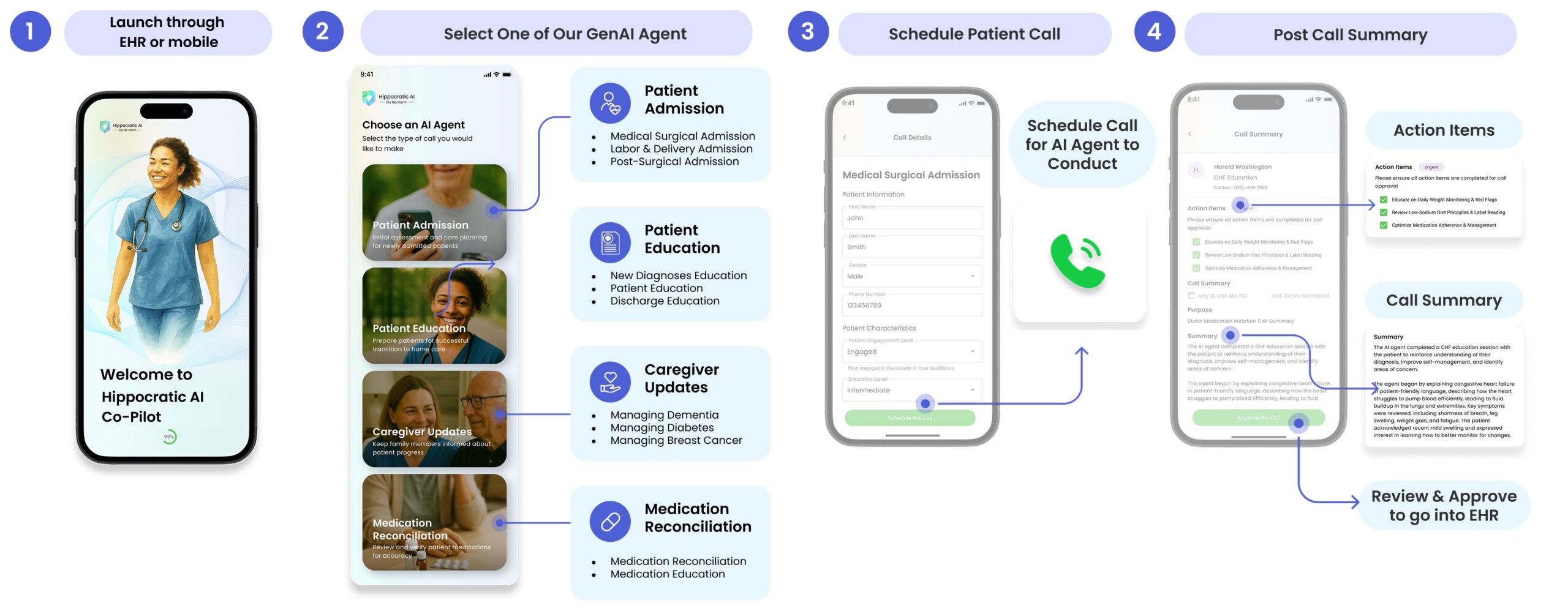
From the beginning, the Co-Pilot has been guided by those who know the work best, the nurses themselves. We’re proud to be co-developing this tool alongside the nurses at Cleveland Clinic, Cincinnati Children’s Hospital, and OhioHealth. Three organizations that share a deep commitment to advancing nursing practice through innovation.
Their partnership ensures that every workflow, every word, every interaction reflects the realities of clinical practice and not just what’s possible with technology, but what’s needed in nursing.
The reality is that we can’t keep asking nurses to do more without giving them the support they deserve. The administrative demands of modern healthcare are not going away, but how we meet them can, and must change.
The Hippocratic AI Co-Pilot is about giving nurses back the time to teach, connect, and care in the ways only nurses can. Because the future of nursing won’t be defined by the technology we build, it will be defined by how that technology helps us be more human.